Your Ultimate Guide to Future of Web Development Technologies in United States
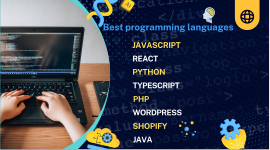
Businesses' need for quicker, more scalable, and highly interactive websites are driving a rapid evolution in the web development industry. In addition to programming languages, developers in 2026 rely on powerful frameworks and platforms that allow for the efficient development of modern online apps.
From Python and JavaScript to platforms like WordPress and Shopify, choose the appropriate technological stack is important for developing high-performance websites and applications.
In this article, the high-demand programming languages 2026 and technologies for web development in 2026 will be discussed in this article, along with their enduring importance in the contemporary digital environment.
JavaScript continues to be the most popular programming language for developing websites. It is suitable with all current browsers and powers interactive elements on webpages.
We concentrate on creating applications that are safe, adaptable, and adhere to platform specifications in addition to being functional. Every public application we create is built to provide an outstanding user experience and is optimised for performance.
JavaScript is now a full-stack development language due to the emergence of current frameworks and backend environments.
One of the most widely used JavaScript libraries for creating contemporary user interfaces is called React. This is frequently used to develop scalable, quick, and dynamic web applications.
React is frequently used to create complex web platforms, dashboards, and single-page applications (SPAs).
One of the most flexible programming languages for creating websites is still Python. It is perfect for both novice and seasoned developers due to its readability and simplicity.
Startups and IT companies are using Python extensively to create scalable platforms and AI-powered websites.
JavaScript has been replaced by TypeScript, which offers more sophisticated programming tools including static typing. For large-scale projects, many modern era development teams now use TypeScript.
PHP is still a powerful server-side scripting language that drives a large amount of the internet.
PHP is particularly helpful for eCommerce platforms, blogs, and content-driven websites.
Wordpress is the world's most popular content management system(CMS). It is used by millions of websites to create online stores, blogs, and business websites.
WordPress is a great option for content-focused platforms, blogs, and commercial websites.
Shopify has become known as one of the most popular eCommerce website development platforms. It helps companies to build and run online stores fast and with minimal technical detail.
For companies looking to launch or grow their online businesses rapidly, Shopify is perfect.
Java is still an effective language for web development at the corporate level. Java is used by many large enterprises to create scalable and secure applications.
Java is frequently utilized in high-traffic applications, enterprise platforms, and banking systems.
Selecting the right programming language or platform depends on your project goals and requirements.
Each technology has its own strengths, and the best choice depends on the type of website or application you want to build.
Contact us today for Web development in 2026 is driven by a combination of powerful programming languages and advanced development platforms. Technologies like JavaScript, Python, TypeScript, React, WordPress, and Shopify are helping developers create fast, scalable, and user-friendly digital experiences.
Businesses that choose the right development technologies can build websites that not only look great but also deliver strong performance, security, and scalability.
As the digital world continues to evolve, staying updated with modern programming languages and platforms will be key to building future-ready web applications and online businesses.
Which programming language is best for web development in 2026?
JavaScript remains the most essential language for web development since it powers both frontend and backend (via Node.js). Additionally, TypeScript is rapidly gaining popularity for large-scale applications, while Python is widely used for AI-integrated web apps.
Is TypeScript better than JavaScript for modern web development?
TypeScript is often preferred for modern web development because it adds static typing, reduces runtime errors, and improves scalability. Many companies are adopting it as a standard for building large and complex applications.
What technologies are trending in web development in 2026?
Key trends include AI-powered applications, cloud-native development, WebAssembly for high-performance apps, and low-code/no-code platforms. These technologies are transforming how modern web applications are built and deployed.
Is Python a good choice for web development in 2026?
Yes, Python is an excellent choice, especially for projects involving AI, machine learning, or data-driven features. Frameworks like Django and Flask make it easy to build secure and scalable web applications.
What skills are required to become a web developer in 2026?
To succeed in 2026, developers need skills in JavaScript/TypeScript, modern frameworks (like React or Next.js), cloud technologies, APIs, and AI integration. Understanding DevOps and scalable architectures is also becoming increasingly important.
