Transforming Web Development with the Power of Artificial Intelligence
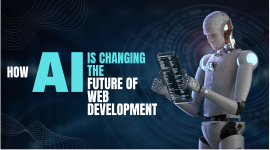
Artificial Intelligence (AI) is at the core of the rapid evolution of the web development industry. A field that was before filled with complex tasks and manual work is now growing more intelligent, effective, and automated. AI is changing how developers create, optimise, and manage websites and applications; it's not just a trend.
One of the most obvious effects of AI in web development is created automated code. These days, AI-powered tools can generate code sections, make completion suggestions, and even create whole components in response to straightforward inputs. This helps developers focus on problem-solving rather than terminology and significantly decreases the overall development time.
Developers might depend on AI assistants to find mistakes, recommend modifications, and enhance code quality in real time rather of spending hours debugging or looking for resolutions.
AI is changing how users engage with websites. Websites can now utilise machine learning algorithms to analyse user behaviour and make dynamic adjustments. This leads to in:
Users are more likely to stick around and engage with a website due to these elements, which provide a more personalised and interesting experience.
By automating tedious processes like testing, debugging, and deployment, Al solutions optimise workflows. Pipelines for continuous development and deploy are getting more intelligent, recognising possible problems before they get to production.
As a result, companies can launch goods more quickly, develop more effectively, and maintain their competitive edge in the rapidly evolving digital market.
Although testing is an essential component of web development, it can take a lot of time. Testing solutions with Al capabilities may automatically create test cases, find errors, and anticipate possible failures.
Developers can maintain excellent applications using little manual labour thanks to these systems, which continuously improve by learning from past mistakes.
AI is making it possible for consumers to engage with websites in ways other than just clicking and typing. User interfaces, voice search, and image recognition are growing in popularity.
In order to create exciting opportunities for creativity, developers now need to think above typical UI design and take into account how consumers interact with voice assistants and visual inputs.
AI is improving accessibility to the web. Tools can automatically generate alt text for images, convert text to speech, and provide real-time translations.
This helps companies achieve accessibility criteria while increasing customer satisfaction by assuring that websites are available by a larger audience, including people who have disabilities.
With little to no coding experience, people may create websites by using systems powered by AI-based website building platforms. These technologies manage backend procedures, make feature suggestions, and create layouts using sophisticated automation. Developers have not been displaced by this, but their job changes with a concentration on system architecture, difficult problem-solving, and customisation.
AI is essential for safeguarding web apps, and cybersecurity is an increasing cause for concern. Artificial intelligence (AI) systems have the ability of real-time threat response, vulnerability identification, and abnormal behaviour detection.
This proactive strategy makes websites safer for both users and companies by detecting attacks before they have a chance to cause damage.
As AI replaces routine tasks, the role of web developers are changing. Developers are becoming to resemble architects and strategists, concentrating on:
Adaptability, critical thinking, and creativity are more crucial than ever.
Web developers are being empowered by Kodrite AI web development solutions, not replaced. AI helps developers to work more efficiently, effectively, and creatively by automating tedious tasks and offering useful information.
The collaboration of humans and machines will influence web development in the future. In addition to being relevant, those who use AI will lead the upcoming wave of digital innovation.
One thing is evident as technology develops further: AI is transforming what is possible rather than simply altering web development.
How is AI changing the way developers build websites?
AI is reshaping how developers approach web development by automating repetitive coding tasks and offering intelligent suggestions. Instead of focusing on manual work, developers can now concentrate on building better functionality, improving performance, and creating more innovative digital experiences.
How does AI contribute to creating user-friendly websites?
AI helps developers design user-friendly websites by analyzing how visitors interact with pages. Based on this data, it can suggest improvements like better layouts, faster navigation, and personalized content, making websites more engaging and easier to use.
In what ways does AI simplify testing and debugging?
AI simplifies testing and debugging by automatically identifying errors, generating test cases, and predicting potential issues before they occur. This reduces the time spent on manual testing and ensures that applications run smoothly with fewer bugs.
Can AI tools support small businesses or beginner developers?
Yes, AI tools make web development more accessible for beginners and small businesses through no-code and low-code platforms. These tools guide users in building websites, suggesting designs, and handling technical processes, making it easier to launch projects without deep coding knowledge.
How will AI influence the future role of web developers?
AI will not replace developers but will evolve their role. Developers will focus more on creativity, problem-solving, and system design, while AI handles routine tasks. This shift will lead to smarter workflows and more advanced, scalable web applications.
